 Jing Bearing
Material Selection Standards for Precision Crossed Roller Bearings in Robotics: From Core Materials to Process Breakthroughs
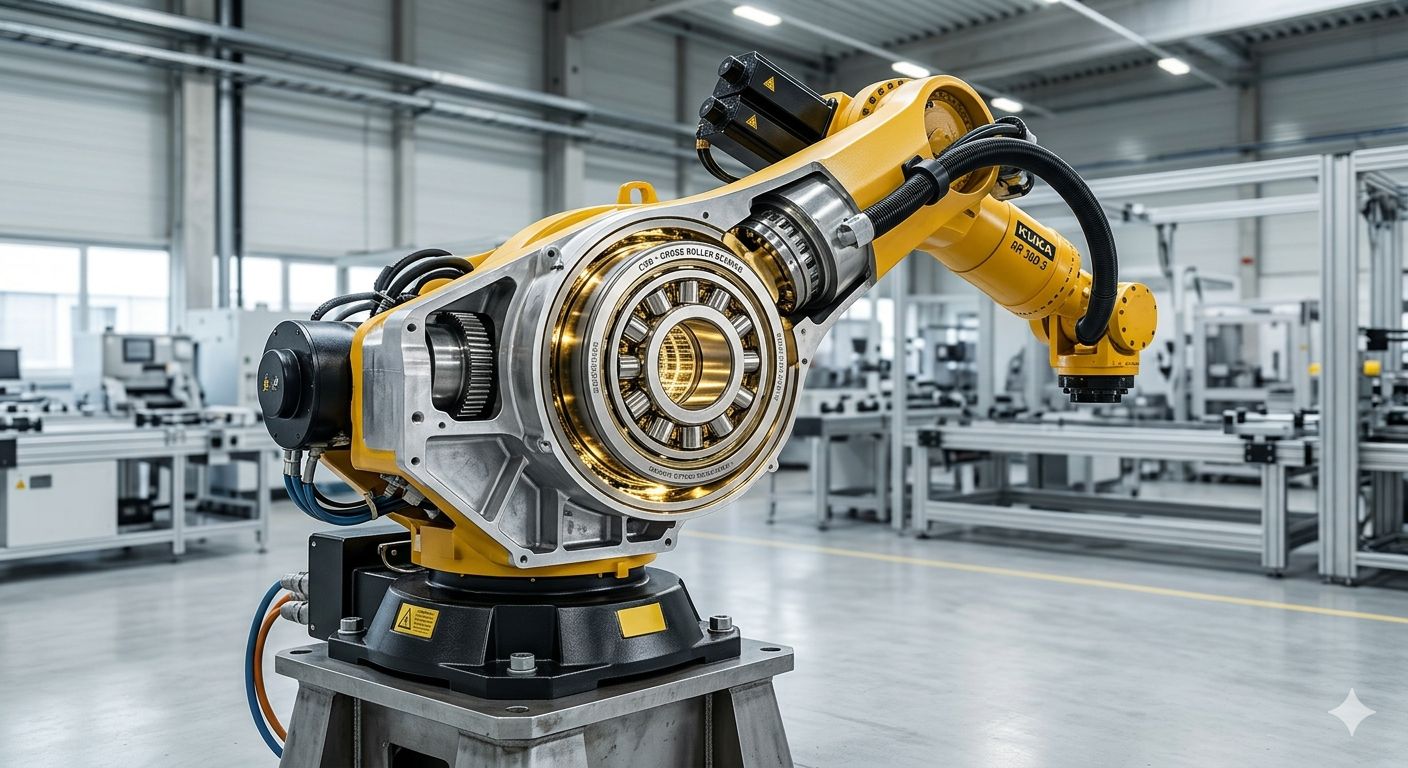
In the joint design of industrial robots, collaborative robots, and even precision rotary tables, **precision crossed roller bearings** have become indispensable core components. The fundamental guarantee behind these bearings' ability to simultaneously withstand multi-directional loads—including radial, axial, and overturning moments—while achieving high rigidity and rotational precision within an extremely compact space, lies in the **scientific selection and rigorous control of materials**.
For **robotic arm bearings**, should the material suffer from fatigue spalling, plastic deformation, or dimensional instability, it would directly result in joint clearance, a decline in precision, or even complete seizure of the robot's joints. So, what specific material selection standards must a high-quality precision crossed roller bearing for robotics adhere to?
I. Rings and Rolling Elements: High-Carbon Chromium Bearing Steel is the Undisputed Champion
Given the demanding operating conditions of robot joints—characterized by frequent starts and stops, heavy loads, and requirements for a long service life—the preferred material for bearing rings and rolling elements is **GCr15SiMn** high-carbon chromium bearing steel. Compared to standard GCr15 steel, GCr15SiMn features increased silicon and manganese content, which significantly enhances its **hardenability** and **wear resistance**. This allows **robotic arm bearings** featuring a thickened design to achieve a uniform high hardness of **HRC 60–62**—even within a limited cross-section—thereby effectively resisting plastic deformation under Hertzian contact stress. For standard crossed roller bearing series (such as the RB series), **SUJ2** (JIS standard) or **100Cr6** (DIN standard) also serve as equivalent, high-quality alternatives. ### II. Rolling Elements: The Precision of Solid Rollers Determines Rotational Accuracy
The rolling elements in crossed roller bearings are cylindrical rollers, arranged in an alternating 90° pattern. To ensure that each roller bears a uniform load and moves smoothly, the roller material must possess extremely high **dimensional consistency** and **surface integrity**. In addition to utilizing GCr15SiMn solid rollers, high-end applications often employ **carburized steel**, which achieves a high-hardness surface while retaining core toughness. For **robotic arm bearings** subject to extremely high load requirements and shock loads (such as the joints closest to the base in heavy-duty handling robots), the Rockwell hardness of the solid rollers must be strictly controlled at **HRC 60 or higher**, with the diameter variation among individual rollers within a batch limited to no more than 2 microns.
III. Cages: Adapting to Operating Conditions—From Nylon to Brass
The cage material in crossed roller bearings directly influences the bearing's limiting speed, vibration and noise levels, and shock resistance:
- **Nylon Cages (PA66-GF25)**: Suitable for general industrial **robotic arm bearings** operating at low-to-medium speeds with low vibration levels; they offer advantages such as self-lubrication, low noise, and low cost. However, under high-frequency shock loads exceeding 15g (such as those experienced in the knee joints of legged robots), nylon cages are prone to fracture.
- **Solid Brass Cages (CuZn39Pb2)**: Possess superior strength, rigidity, and thermal conductivity, making them suitable for precision rotating components involved in high-speed operation or frequent start-stop cycles that generate significant inertial shock. For heavy-duty **robotic arm bearings**, brass cages can significantly extend the bearing's shock fatigue life.
- **Stamped Steel Cages**: While meeting structural strength requirements, these cages feature a thinner profile that helps reduce the overall weight of the bearing, making them ideal for weight-sensitive collaborative robot designs.
IV. Surface Treatment and Dimensional Stability: The Unseen Safeguards of Long-Term Precision
Beyond the base material itself, the material selection process for precision crossed roller bearings also encompasses subsequent processing techniques. Under prolonged stress, residual austenite within bearing steel undergoes phase transformation, leading to minute dimensional changes in the bearing's inner and outer rings. For **robotic arm bearings**—which require maintaining a repeatable positioning accuracy of less than 10 arc-seconds over extended periods (e.g., 20,000 hours)—the bearing rings must undergo **dimensional stabilization treatments** (such as tempering at temperatures like M50 or M190, combined with cold treatment) to limit residual austenite content to below 3%. Additionally, some high-end bearings feature **black oxide** or **phosphating** surface treatments to enhance resistance to fretting wear and provide short-term rust protection.
V. Derivative Materials for Specialized Application Environments
If a robot's end effector is required to operate in humid environments, in the presence of corrosive gases, or within a cleanroom setting, standard bearing steel is prone to rusting and causing contamination. In such cases, alternative material options include:
- **SUS440C Stainless Steel:** Achieves a hardness of HRC 58–60 and offers excellent corrosion resistance, making it suitable for food-grade or medical robots.
- **Silicon Nitride (Si₃N₄) Ceramic Balls** paired with steel raceways: Although higher in cost, this combination increases maximum rotational speed limits and reduces centrifugal forces, making it ideal for high-speed SCARA robots or compact collaborative robots.
#Conclusion: Material Selection—A Systems Engineering Challenge Balancing Performance and Cost
Selecting materials for precision crossed roller bearings used in robotics is not merely a pursuit of the "most expensive" material grade; rather, it involves a comprehensive trade-off based on **load profiles, rotational speeds, service life requirements, operating environments, and cost constraints.** From GCr15SiMn bearing steel to reinforced cages, and from surface stabilization treatments to stainless steel or ceramic-based solutions, every step in the material selection process directly impacts the robotic arm's operational rigidity, positioning accuracy, and service life.
As a manufacturer specializing in the R&D and production of **precision crossed roller bearings**, Luoyang Jing-Bearing Technology Co., Ltd. deeply understands the decisive role that the aforementioned material selection criteria play in ensuring the long-term, reliable operation of **robotic arm bearings.** Our company maintains rigorous control over the entire process—from the procurement of **vacuum-degassed bearing steel** to the **low-temperature tempering and dimensional stabilization treatment**—to ensure that every **robotic arm bearing** and specialized rotary component bearing leaving our facility meets the high-rigidity, high-precision, and long-lifespan requirements of industrial and collaborative robotic applications.
 Jing-Bearings Bearing