 Jing Bearing
How Does Luoyang Jincheng Technology Co., Ltd. Control the Quality of Slewing Bearing Forgings?
In numerous fields—such as construction machinery, wind power generation, and defense equipment—slewing bearings are hailed as the "joints of machines," and their quality directly determines the safety and service life of the entire piece of equipment. Within the entire manufacturing chain, **forging quality** serves as the primary "critical lifeline" that dictates the ultimate performance of a slewing bearing.
This article will provide an in-depth look at how Luoyang Jincheng employs **comprehensive, closed-loop management** across its entire process to ensure that every slewing bearing forging possesses exceptional mechanical properties and reliability.
I. Interception at the Source: Guarding the First Gate—"Raw Materials"
For slewing bearings, the quality of the steel determines the very "genetic makeup" of the final product. Luoyang Jincheng fully understands this principle and has adopted standards for raw material control that are nothing short of "rigorous."
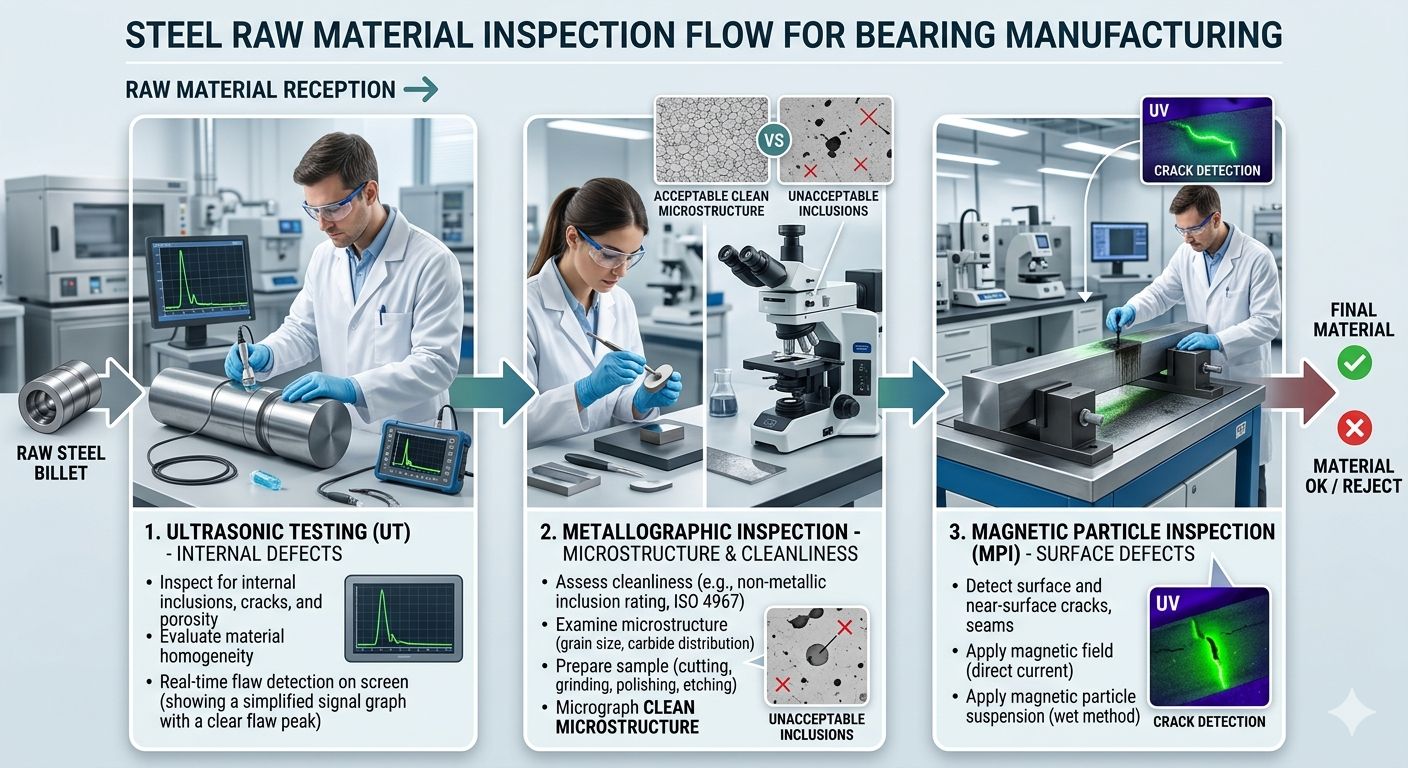
* **Strict Supplier Selection and Re-verification:** The company not only carefully selects high-quality domestic suppliers of alloy steel but has also established an inviolable rule: "Inspect first, then warehouse." Upon arrival at the facility, no batch of steel is immediately fed into production; instead, it must first be sent to the laboratory for a thorough "physical examination."
* **Multi-dimensional Incoming Inspection:**
* **Chemical Composition Analysis:** Utilizing **spectrometers**, the company precisely measures the content of alloy elements—such as carbon, chromium, and manganese—and **strictly limits harmful impurities, such as sulfur and phosphorus, to no more than 0.025%**, thereby ensuring the material meets—or even exceeds—national standards.
* **Low-Magnification Structure and Inclusion Inspection:** Through acid etching tests, the steel is examined for defects such as central porosity or shrinkage cavities. This ensures that the material's internal "purity" meets the required standards, thereby eliminating—at the very root—any latent risks that could lead to cracking.
The core value of this stage lies in **intercepting substandard raw materials at the gate before they enter production**, thereby preventing potential defects from being carried forward into subsequent processing stages that represent an investment of tens of thousands of yuan.
II. Forging and Forming: Endowing the Product with Strong, Resilient "Bones"
Forging is not merely a process of altering shape; it is a critical step in reshaping the metal's internal microstructure and enhancing its mechanical properties. In the forging stage, Luoyang Jincheng demonstrates an exceptionally high level of process control. * **Mature Forging Processes:** The company employs precision forging techniques—such as **upsetting, punching, and ring rolling**—to significantly enhance the impact resistance and fatigue strength of its forgings.
* **Real-time Process Monitoring:** During the forging process, operators strictly control both the initial and final forging temperatures. Immediately after the billet is removed from the furnace, visual inspections and dimensional measurements are performed to ensure that an appropriate machining allowance is maintained.
III. Heat Treatment & Tempering: The "Core Code" for Controlling Hardness and Toughness
Heat treatment is the pivotal stage in the transformation of a slewing bearing's performance characteristics. Both the wear resistance of the raceways and the dimensional stability of the component stem from this process. Luoyang Jing Bearing regards heat treatment as the **"absolute priority" in quality control.**
* **Precise Quenching & Tempering and Raceway Hardening:** Based on the product's specific application scenario, the company performs **quenching and tempering** to enhance overall mechanical properties, followed by **medium- or high-frequency induction hardening** on the critical raceway surfaces.
* **Dual Compliance: Hardness and Effective Hardening Depth:** Following heat treatment, quality inspectors conduct **multi-point hardness testing** on the raceways to ensure that surface hardness is strictly maintained within the **HRC 55–62** range. Simultaneously, they verify the effective hardening depth to guarantee the desired "hard exterior, tough interior" material structure.
* **Metallographic Analysis:** Through observation under high-magnification microscopes, the company ensures that the martensitic structure grade and residual austenite content meet established standards, thereby **eliminating any risk of overheating, burning, or decarburization.**
IV. Non-Destructive Testing & Precision Measurement: A "Full Physical Exam" for Forgings
Luoyang Jing Bearing has established multiple "inspection checkpoints," utilizing advanced instrumentation and equipment to conduct comprehensive screening of its forgings.
* **100% Ultrasonic Testing (UT):** This serves as the critical method for detecting internal defects. This process enables the **precise identification of internal flaws—such as white spots, porosity, shrinkage cavities, or inclusions**—thereby ensuring that the internal structural integrity meets all required standards.
* **Magnetic Particle Testing (MT):** Specifically employed to detect minute cracks located on the surface or just beneath the surface of the forgings. * **CMM and Physicochemical Inspection:** Utilizing **Coordinate Measuring Machines (CMMs)**, we conduct precise verification of the forgings' dimensional tolerances, roundness, and parallelism, ensuring that the accuracy of the raw blanks meets the machining requirements for P0/P6 precision grades.
V. Establishing a Comprehensive Process Traceability System
At Luoyang Jing Bearing, quality control is not an isolated step, but rather a continuous chain that spans the entire production lifecycle.
The company has established a comprehensive system of **quality traceability records**. From the furnace numbers of raw material melts and forging temperature logs to heat treatment curves and operator details, all data is entered into a centralized system and archived for long-term retention.
This means that **should even a minor quality issue be detected during subsequent processing stages, our technical team can utilize the "traceability system" to quickly pinpoint the specific source batch, immediately analyze the root cause, and implement corrective and preventive actions.**
 Jing-Bearings Bearing