 Jing Bearing
How do you select the dimensions for a slewing bearing used in a satellite antenna?
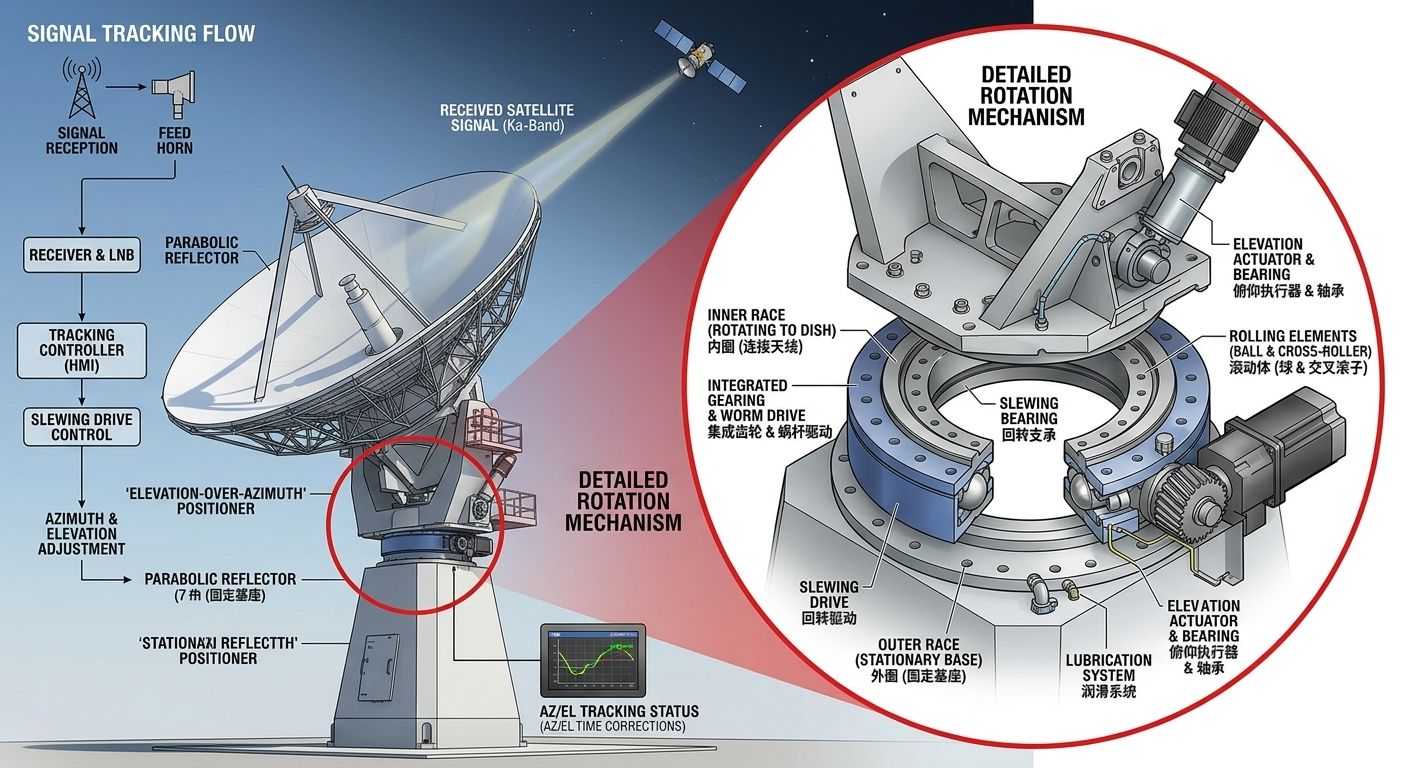
In satellite communication systems, antennas are required to maintain high-precision alignment with target satellites over extended periods. Whether for fixed ground stations, vehicle-mounted "communications-on-the-move" (COTM) systems, or shipborne satellite antennas, the slewing bearing serves as the core component enabling smooth rotation and precise tracking. Selecting the appropriate slewing bearing size is critical; it not only determines the operational reliability of the antenna but also directly impacts the overall service life of the equipment and the quality of the signal.
However, during the actual selection process, many individuals tend to overlook the necessity of correctly matching the bearing's "load-bearing capacity" with the "actual operating conditions." Drawing upon the manufacturing capabilities of Luoyang Jingcheng Technology Co., Ltd. as a case study, this article systematically outlines the logical framework for selecting slewing bearing sizes for satellite antennas, thereby helping engineers and procurement professionals avoid common pitfalls.
Three Easily Overlooked Selection Details
1️⃣ Bolt Connection Strength
In many cases, the raceway load-bearing capacity of a slewing bearing used for satellite antennas is sufficient, yet the connecting bolts fail first.
It is imperative to verify the stress on the bolts under the specific axial load (Fa') and tilting moment (M'), and to tighten them according to the manufacturer's recommended torque. During production, Luoyang Jingcheng Technology provides simultaneous recommendations regarding appropriate bolt grades and pre-tightening torques to prevent the mismatch scenario of "a large bearing paired with small bolts."
2️⃣ Clearance and Tracking Accuracy
Antenna tracking applications require the rotational clearance to be as minimal as possible. During the selection process, it is essential to explicitly specify requirements for "zero clearance" or "negative clearance" (pre-load); otherwise, issues such as tracking lag or zero-point jitter may occur. This point is particularly critical for mobile antennas, such as those used in "Communication-on-the-Move" (COTM) systems.
3️⃣ Corrosion Protection and Sealing
Outdoor antennas are directly exposed to sunlight and rain; therefore, their slewing bearings must be equipped with reliable sealing strips, and the raceways should undergo phosphating or galvanizing treatments. Luoyang Jingcheng Technology has incorporated comprehensive standards for surface protection and sealing assembly requirements into its quality management system, ensuring adaptability to diverse outdoor operating environments across different regions.
IV. Why Is It Not Recommended to Select Bearings "Solely Based on Antenna Diameter"?
Many users are accustomed to saying: "My antenna is 2.4 meters in diameter, so I'll just use a slewing bearing with an outer diameter of around 600 mm." This is a high-risk approach.
Consider two identical 2.4-meter antennas:
• In regions with low wind speeds (e.g., inland areas), a model such as the 011.30.560 (outer diameter approx. 600 mm) may suffice;
• In coastal regions prone to typhoons, it may be necessary to upgrade to a larger model—such as the 011.35.710 (outer diameter approx. 760 mm)—to ensure safety.
The correct procedure for selecting the appropriate size is as follows: Load Calculation → Preliminary Type Selection → Load Curve Verification → Bolt Verification → Final Model Determination.
If you lack access to specialized selection software, you may contact Luoyang Jingcheng Technology directly; they can provide load verification services and specific model recommendations for slewing bearings intended for satellite antenna applications.
- previous:How to Choose Bearings for Food Processing Robots?(2026/5/18)
 Jing-Bearings Bearing