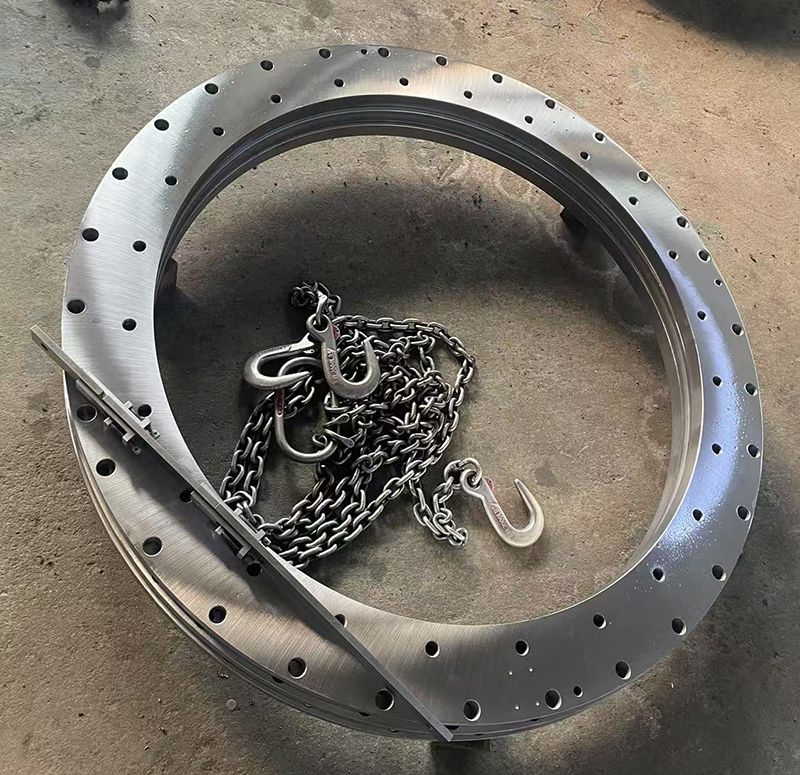
In the field of high-end equipment manufacturing, bearings are hailed as the "joints of industry." Recently, Jing Bearing Bearing Co., Ltd. announced a major development: a four-point contact slewing bearing—custom-engineered specifically for a certain Chinese nuclear project—has successfully completed production and passed rigorous acceptance testing. This combined slewing bearing—featuring a diameter of 1.2 meters, P5-grade precision, and construction using special military-grade materials—marks a solid step forward in my country's localization of core components for nuclear power, distinguished by its exceptional rotational precision of 0.02 mm.
The "Joints" of Nuclear Power Equipment: Why Must They Be Four-Point Contact Slewing Bearings?
Nuclear projects impose nearly uncompromising requirements on equipment reliability. Critical components—such as reactor control rod drive mechanisms, nuclear fuel transfer equipment, and large-scale rotary supports within the nuclear island—demand bearings capable of operating stably over long periods amidst environments characterized by intense radiation, extreme temperature differentials, and heavy loads.
The four-point contact slewing bearing has emerged as the preferred choice for nuclear projects due to its unique structural design: the steel balls form four distinct contact points with the raceway, enabling the bearing to simultaneously withstand axial forces, radial forces, and overturning moments. Compared to standard bearings, this design achieves superior load-bearing capacity and rigidity within a compact footprint, making it particularly well-suited for the precise positioning and smooth rotation of large-scale rotary components within nuclear facilities.
Decoding the Core Parameters: What Do a 1.2-Meter Diameter, P5-Grade Precision, and 0.02 mm Rotational Accuracy Signify?
The bearing recently completed by Jing Bearing boasts technical specifications that fully align with—and benchmark against—advanced international standards:
• **1.2-Meter Diameter:** Classified as a large-scale slewing bearing, it is deployed in heavy-duty rotary mechanisms within nuclear projects—such as the turntables for nuclear fuel handling cranes and reactor vessel head lifting devices.
• **P5-Grade Precision:** In accordance with the national standard GB/T 307.1, P5 represents a high-precision grade—far exceeding that of standard slewing bearings. This signifies that the dimensional tolerances and geometric tolerances of the inner ring, outer ring, and rolling elements are strictly controlled, thereby guaranteeing smooth and stable operation under conditions of high speed or heavy load. • **Rotational Precision of 0.02 mm:** This signifies that, under no-load or light-load conditions, the bearing's radial runout and axial runout are controlled within 0.02 millimeters—equivalent to one-third the diameter of a human hair. For the precise alignment and positioning scenarios critical to nuclear projects, this level of precision directly determines the equipment's safety redundancy and service life.
• **Military-Grade Specialized Materials:** The bearings utilize radiation-resistant, high-temperature-resistant, and corrosion-resistant specialized steels or ceramic-composite coating materials. This ensures that the bearings remain free from intergranular corrosion or dimensional instability even when operating in extreme environments characterized by neutron irradiation, high humidity, or aggressive chemical atmospheres.
**Overcoming Technical Hurdles: How to Manufacture Large-Scale, High-Precision Four-Point Contact Slewing Bearings?**
Manufacturing a 1.2-meter-diameter four-point contact slewing bearing for nuclear applications presents three major "roadblocks":
1. **Controlling Heat Treatment Deformation in Large Raceways:** The larger the diameter, the more difficult it becomes to control elliptical deformation during the quenching process. Jing Bearing employs a process combining induction quenching with precision tempering—augmented by proprietary, self-developed specialized tooling—to maintain raceway hardness fluctuations within a tight tolerance of ±1 HRC.
2. **P5-Grade Grinding Precision:** The curvature radius and groove-side deviation requirements for four-point contact raceways are exceptionally stringent. The team utilizes high-precision CNC vertical grinding machines, integrated with an online measurement and compensation system, to achieve grinding precision at the micron level.
3. **Assembly for 0.02 mm Rotational Precision:** Critical assembly steps—such as the grouping of rolling elements, adjustment of cage clearances, and setting of preload forces—require iterative refinement. By employing high-precision sorting instruments and cryogenic assembly techniques, the team ensures that the final bearing clearance consistency meets all design specifications.
**Self-Reliance and Control: From "Chokepoints" to a "Chinese Core"**
For a long time, the high-end slewing bearings required for major nuclear initiatives—such as nuclear power plants—were heavily dependent on imports. This not only resulted in lengthy delivery lead times but also exposed projects to risks associated with technological blockades and supply chain vulnerabilities. Jing Bearing's successful delivery of these four-point contact slewing bearings for a nuclear project marks a pivotal milestone: it demonstrates that domestic enterprises have now mastered the entire technological chain—spanning material formulation, heat treatment processes, precision machining, and dynamic testing. It is reported that this bearing has successfully passed simulated irradiation accelerated aging tests, 5,000-hour heavy-load fatigue tests, and thermal shock tests ranging from -40°C to 200°C; all performance indicators meet or exceed the design specifications for nuclear projects. The Chief Engineer of a major Chinese nuclear project remarked: "The precision and reliability of this bearing have reached the level of comparable imported products, and in some parameters, they even surpass them."
**Industry Significance: Driving the Upgrading of the Entire Nuclear Power Equipment Supply Chain**
A single megawatt-class nuclear power unit requires over 2,000 sets of various bearings. Among these, large-scale, high-precision four-point contact ball slewing bearings represent one of the highest-value categories and present the greatest manufacturing challenges. Jing Bearing success not only fills a critical gap in domestic manufacturing capabilities but will also drive the synergistic development of upstream sectors—including special steels, precision tooling, and testing instrumentation.
Currently, the company is developing a next-generation four-point contact ball slewing bearing for nuclear applications, featuring a diameter of 1.6 meters and P4-grade precision. This product is targeted for use in Generation IV nuclear reactors and floating nuclear power stations. It is foreseeable that, as the pace of localization accelerates, the "joints"—the critical moving components—of China's nuclear projects will become increasingly autonomous, secure, and reliable.
**Conclusion**
A 1.2-meter diameter, P5-grade precision, military-grade special materials, and a rotational accuracy of 0.02 mm—with these impressive, hard-core metrics, Jing Bearing has redefined the new domestic benchmark for four-point contact ball slewing bearings used in nuclear projects. This represents not merely a technological breakthrough for a single enterprise, but a microcosm of China's nuclear power equipment industry moving toward complete autonomy and independent control. Looking ahead, we anticipate that more specialized, sophisticated, and innovative enterprises like Jing Bearing will continue to tackle critical technical challenges in strategic fields—such as nuclear energy, aerospace, and deep-sea exploration—forging the robust "joints" that empower the nation's monumental industrial machinery.
Besides standard slewing bearings and slewing drives, Jing-Bearings Bearing also provides processing of machine tool parts and non-standard mechanical parts.
Contact Us